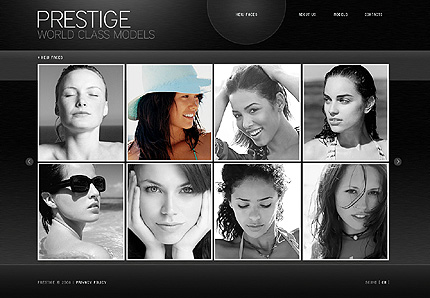
In the past, hard copy photos was all a model needed. In this day and age of the Internet, however, it's all about those digitals! While traditional hard copy modeling portfolios are a collection of a model's best pictures all contained in a special display case/book, online modeling portfolios are basically a collection of images that are displayed on the Internet, such as a model's official website, social networking site or other photo sharing site where you can create albums with links to your work.
When a photographer, agency or client asks to see your online portfolio, you'll typically give them links to where they can view your stuff. In other instances, this could involve simply emailing them a few of your best images as individual file attachments. So there are a few ways that having an online portfolio works.
Before you can create an online portfolio, you have to do shoots so first thing's first: get to shooting!
Now that you've gotten a handful of useable modeling images, here are the steps you'll need to get an online portfolio together for submission to future clients:
Get The Right Type of File
Jpegs are the most universal type of file to receive your photos in. Anytime you are receiving images from a photographer or client, make sure to ask for jpegs. In most cases, they automatically know so this shouldn't be a problem.
In the event that you have modeling pictures that are not in a jpeg format, you can change the file type in any version of Adobe Photoshop. Don't have it? Download a free trial version. Simply open up the file in question, click the "File" tab in the top left-hand corner and select the "Save As" option. Before you hit the "Save" button, make sure you hit the drop down menu in the field titled "Format" and choose the JPEG option. Then you can officially save the file.
Create the Right Sizes
A few posts back I mentioned making it a habit to not send monstrously huge image files to clients. This also holds true for online modeling portfolios and websites where they have size restrictions on the images you upload. What you want to do is take your original modeling image file and resize it properly. Avoid making your image too small, however.
What I've found to be extremely helpful is having different sizes for each of my photos stored in their own folders on my laptop. For every photo I get from a shoot that I want to display online, I first use Microsoft Office Picture Manager to resize them (I work on a PC, Windows 7 operating system). This program has its own resize section, is super easy to use and even has predetermined sizes that you can select.
So basically, I have 3 different sizes of my hi res files (I always keep the hi res originals of my images on a backup hard drive):
- My "large" images usually range from 500 kb - 900 kb, so just under 1MB.
- My "medium" images usually range from 100 kb - 499 kb.
- My "small" images usually range from 50 kb - 99 kb.
The resizing aspect is important for when you plan on emailing your modeling portfolio images individually as file attachments. Already having set sizes for each will make the process less time consuming when selecting files to attach. When it comes to email, unless the client asks for hi res images, stick to medium or small sized files. This will prevent the likelihood that someone will try to steal your image and manipulate it.
Display Your Photos
Now that you've got your modeling pictures sized properly and in the right file format, you can display them on the Internet to begin marketing yourself. For social networking sites like Facebook and Model Mayhem, your uploaded photos will generally be resized automatically by the site, which is fine. Of course the sites will tell you the max size for each upload so as long as you follow each one's requirements, you should be fine during this part of the process.
When posting your online modeling portfolio, it is best to include a photo caption and credits, if possible. The name of the project, year, location, etc. is ideal as a description but you don't want to make it too detailed (i.e. Spring 2012 Catalog Shoot for X Brand, Los Angeles, CA is a good caption).
Be good about crediting the photographer and anyone else involved in the shoot/show/project as well. This includes the makeup artist, hair stylist, wardrobe stylist, designer, brand/company, etc. If it was just you and the photographer, then obviously you'd only credit the photographer but if you want to pat yourself on the back for doing your own hair and makeup, that's fine, too. :-)
Watermarking your images is also important. It's not mandatory but it's helpful for keeping your images protected so that someone can't right-click, do a "Save As" and try to pass off the images as their own (shady photographer wannabes sometimes do this).
***Don't have a clue about what watermarking is or what it's for? Don't worry, I plan on doing a post or two about "watermarking" so be on the lookout for those in the near future.***
Comments